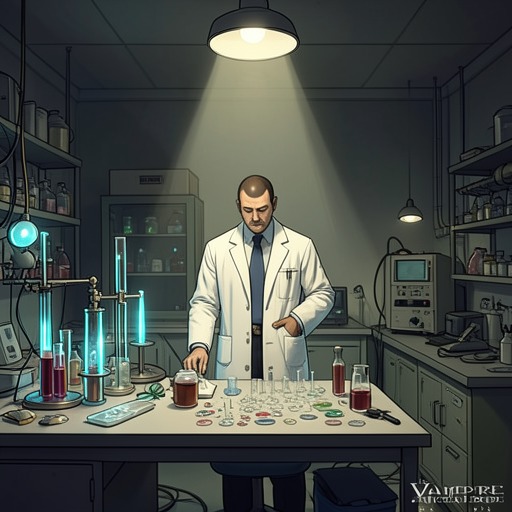
Din
The Vampire Prince’s BrideDin is the Stlozyn Science Alpha, a dragon-like alien whose scientific authority and command of a ship make him one of the principal agents of Libba Ross’s abduction and captivity. He represents the book’s starkest fusion of scientific advancement with coercive power: human DNA may offer the Stlozyn a cure for infertility, but Din’s response is to seize a human woman and reduce her body to an instrument of species survival. His death during the attempted recovery of Libba ends his immediate control, but not the larger system that made his actions possible.
Identity and Authority
Din first appears through the violence of his physical form. He abducts Libba while she is hiking alone in the countryside, diving at her as a dragon, carrying her away in his claws, and depositing her aboard a ship. Once inside, he transforms into a man with orange scales and blood-red eyes. He tells her that they are leaving the solar system, and when she resists, he injects her with a substance that renders her unconscious. The transformation between dragon and humanoid form gives him both an alien identity and practical control over the human captive, while the ship places Libba beyond the reach of her home and ordinary institutions.
Din identifies himself as Din and explains that he is the Science Alpha of the vessel. The title is not merely academic. He says that he commands the ship and is effectively its king while they remain aboard, presenting scientific office and sovereign authority as interchangeable. His pleased comparison of himself to a king exposes his vanity, while the absence of guards in the ship’s corridors later demonstrates the confidence produced by that authority. Din assumes that command, technology, and biological expertise will be enough to keep his prisoner contained.
Scientific Program and Treatment of Libba
Din’s central concern is the Stlozyn infertility plague. He explains that the disease has made his species infertile and that an infusion of human DNA can reverse its effects. He further claims that human women can become pregnant by a dragon even without the cure. This information reframes Libba’s abduction: she has not been selected for companionship or ordinary political exchange, but because her human biology is considered reproductively useful to the Stlozyn.
The cure itself has already altered the structure of Stlozyn society. The dragon who developed it has been promoted to the Science Board, described as the highest level of government, yet synthesis remains slow and distribution has so far been limited to dragonesses. Din justifies that allocation through reproductive arithmetic: one dragon can impregnate many dragonesses, so curing females is treated as the more efficient priority. His explanation is presented as public policy, but it also reveals the logic governing his private actions. Individual consent disappears beneath species-level calculations, and a human woman becomes an expedient alternative while institutional research continues.
Din’s manner makes the exploitation personal. When Libba does not understand his terminology, he tells her that he has forgotten she knows nothing and smiles as though enjoying the insult. He speaks of the infertility crisis as a scientific problem while disregarding the terror of the person whose body is meant to solve it. Libba’s fear that she may be boiled down, eaten, or otherwise processed for her physical substance captures the grotesque uncertainty Din creates: his clinical language does not make his intentions humane, because it leaves her unable to distinguish reproduction, experimentation, and consumption.
Conflict with Libba and Brask
Din’s authority depends on Libba’s confinement, but his control is immediately unstable. After Brask reaches the holding cell, Libba does not passively accept rescue. Bruised, bloodied, and frightened, she strikes at the alien who enters. That reaction emphasizes how thoroughly Din’s abduction has destroyed her ability to trust an unfamiliar rescuer. Din’s treatment has produced a situation in which even escape initially appears dangerous, while the human captive must fight her way through competing alien claims over her body.
Brask’s intervention exposes Din’s arrogance. The Justice Warrior reaches the cell without being challenged because no guards patrol the corridors. Although the cell is protected by a passcode, Brask tears through the metal door instead of treating the lock as a meaningful barrier. Din’s security arrangements therefore fail not because Brask possesses superior access, but because Din has assumed that his institutional position makes direct resistance unlikely.
Din nevertheless attempts to reclaim Libba through official power. He contacts Brask through a tablet and declares that the Science Board has sent him to retrieve the human female Brask took from Earth. The message turns Libba’s captivity into a jurisdictional dispute: Din invokes the authority of the state and the Science Board, while Brask’s claim rests on his decision to protect her and on her pregnancy with his child. Libba hears the exchange as a renewed threat, fearing that Din may be lying or may simply intend to return her to experimentation. Her preference that he abduct someone else instead reveals how completely his conduct has made human reproduction appear as a field of interchangeable victims.
Death and Consequences
Din’s final attempt to recover Libba takes place during the launch of his transport ship. He is confronted by Brask and Biryl, whose resistance prevents him from escaping with the captive or consolidating his claim. Brask attacks the departing vessel, slamming his body into it and forcing it back to the ground. He then tears Din from the ship through the view shield and throws him down, intending to frighten him rather than kill him. That restraint is significant: Brask’s immediate aim is justice and protection, not simple execution.
The confrontation turns fatal when one of Din’s thugs attacks. Biryl clamps onto the attacker’s throat, while the thug’s tail sends spikes toward Din. Brask reaches the scientist at the moment the spikes impale Din’s chest. Din’s death is therefore caused by the violence of the recovery operation and by the forces he brought with him, rather than by Brask’s deliberate decision to kill him. His eyes remain open as his body jerks and then lies still, ending the Science Alpha’s personal pursuit of Libba.
Din’s death removes the immediate captor but does not resolve the moral and political crisis behind the abduction. The Stlozyn still face infertility, the Science Board still treats reproductive capacity as a scarce governmental resource, and human DNA remains valuable within that system. Din is consequently more than an isolated villain. He is the concentrated form of a social order that calls coercion research, calls possession treatment, and measures human worth through reproductive utility. His command collapses in the rescue, but the larger conflict between scientific survival and bodily autonomy remains visible after him.